Show up the right way in the new era of booking.
Winning the relationship isn't just about loyalty programs anymore. It's about showing up where and how guests now discover, research, and book.
The stability is ending
For two decades, loyalty ran on touchpoints the brand controlled: site, app, call center, front desk. AI agents and new booking interfaces are now inserting themselves into every stage of discovery, comparison, and commitment.
Read the full argument
For two decades, travel & hospitality brands built loyalty around a stable set of touchpoints: a website, a mobile app, a call center, a front desk. Guests searched, compared, and booked inside channels the brand controlled — and loyalty programs rewarded them for staying inside those channels. AI agents, large language models, and new booking interfaces are now inserting themselves into every stage of trip discovery, comparison, and commitment.
The relationship starts earlier
Guests increasingly start the search with an AI assistant, not a hotel's app. The relationship starts earlier than it ever has — and so does the competition for it.
Read the full argument
Guests increasingly start their search with an AI assistant, not a hotel's app. The relationship now starts earlier than it ever has — and so does the competition for it. The brands that build for this moment will be first in line when the guest is ready to plan. The brands that wait will find themselves competing for attention inside someone else's interface.
The numbers behind the shift
Loyalty built on data, context, and decisions outlasts loyalty built on rules.
| Old model — rules-based tiers | New model — data + context + decisions |
|---|---|
| Static and historical | Dynamic and real-time |
| One-size-fits-segment | Individual and predictive |
| Rewards apply after the fact | Rewards target what drives the next trip |
Context is what AI adds to the mix. It's the layer that turns "we have data on this guest" into "we know this guest, right now, on this trip." Loyalty programs are a form of CX — the brands that build theirs that way will create the kind of trust and recognition that no points balance can replicate.
Seven decisions on one flight. Not one of them was a discount.
On a single domestic flight, United made seven separate decisions about one traveller. Before: food pre-ordered from the seat map, a proactive "leave now" nudge carrying live drive time, a weather alert the pilot then echoed word-for-word on board. During: a seat-back screen that recognized the traveller by name and resumed a film at the exact timestamp it had been left. After: an arrival welcome with things to do nearby, and an apology for the delay — with points — before anyone thought to complain.
No offer. No promotion. No rate.Every decision spent effort on making the trip seamless and on making it unmistakable that the brand knew who was travelling. That is what data, context and real-time decisioning buy you — and it is exactly what a rules table cannot produce, at any tier. (United isn't a Blend client — just the model, working.)
All seven decisions, and the data each one required
- Pre-order food and beverage from the seat map before boarding. — order history, seat assignment
- Proactive leave-time notification with live drive duration to the airport. — location, live traffic, security wait data
- Weather alert with flight impact, sent before it became a question. — weather feed joined to the flight record
- The pilot echoed the same message on board — one brand, one story. — shared operational messaging layer
- Arrival welcome with things to do in the destination city. — destination, stated preferences
- Seat-back screen recognized the traveller and resumed the film at the exact timestamp. — in-flight entertainment state tied to identity
- Delay apology with bonus points, issued proactively. — disruption detection, service-recovery rules
Every one of these is a decision made from data the brand already had — joined, in context, at the moment it mattered. None of them required a new loyalty tier.
Not a concept deck. A working booking experience.
Meridian Resorts is a brand we invented so the argument could be concrete. Everything it does is buildable today with systems most travel companies already own — which is the uncomfortable part.
No dates-and-destination box. The guest is recognised — tier, home city, past stays, who travels with her — and the first question is what she wants to do, not what she wants to search.
Guest intelligence, availability, loyalty & offers and personalization hand off in the open, reading the guest graph, the reservation system and the offer catalogue in real time.
Each property comes with a reason. The fifth-night-free offer surfaces because she's Gold at that property. The excursion is suggested because she's travelling with her kids — and it says so.
Flight number, airport pickup, the child's allergy, the early dinner — captured once, written back, and waiting on the staff console before she lands.
Walk the full sequence
1 · Recognition. She arrives already known — Horizon Gold, Dallas, two prior stays, stated preferences. The conversation starts from the relationship, not from a blank form.
2 · Plan, then search. "What kind of getaway are you looking for?" replaces destination-and-dates. Intent comes first; inventory is fitted to it.
3 · Orchestration in the open. A concierge orchestrator dispatches specialist agents and shows the handoffs live. It is a control surface, not a chatbot.
4 · Curated, with reasons. A short list of properties, each with the argument for it stated in plain language.
5 · The offer that fits. Stay four nights, get the fifth — surfaced because of who she is and where she's staying, not because everyone got the email.
6 · Attach, then arrive. Excursions chosen for the kids, bundled at booking. Flight number captured, car service dispatched, room readied.
7 · The staff side. A management view flags the severe peanut allergy, the tier, the flight, the connecting room — and offers the actions: brief F&B, welcome basket, kids' amenities, dispatch the car.

Nothing here is hard technology. It's a thoughtfully designed system on top of data you already have.
The right-hand column — the agentic guest experience — is the easy half. The left-hand column is the work: a guest graph that resolves to one person, reservation and offer systems an agent can actually read and write, retrieval fast enough to hold a conversation, consent and governance that hold up, and an orchestration layer to sit above all of it.
That's the honest sequence. When most of the left is already true, a working alpha of the right is a question of weeks, not quarters. When it isn't, that gap is the roadmap — and it's the part worth starting now, because the experience itself will be commodity long before the plumbing is.
Same guest. Same brand. Two very different trips.
Pick a guest at the fictional Solstice Hotels & Resorts and walk their journey. At every step, compare what a rules-based program does with what an AI-decisioned program does — and why it matters.


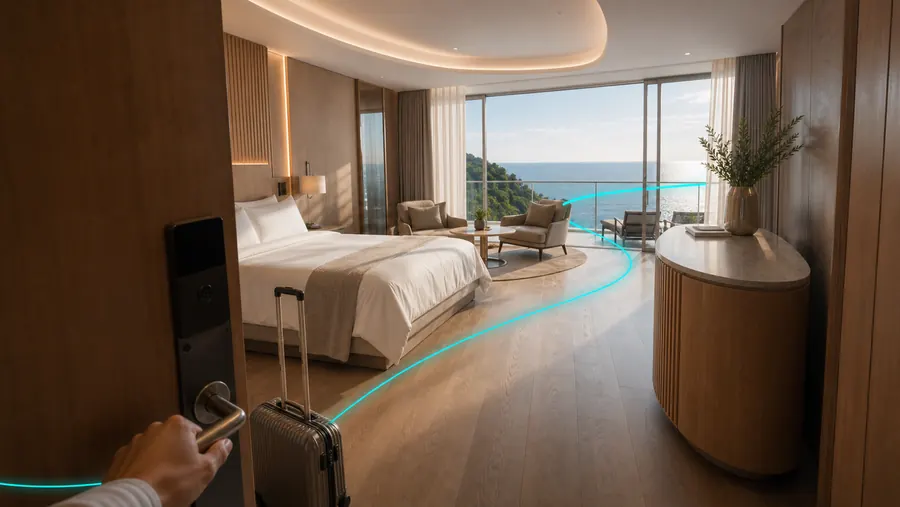
The booking moment is moving. Here's what has to be true.
One argument, in three moves: the moment is moving away from you, so your program has to know each guest individually — and spend where that knowledge actually changes the trip.
The booking moment is moving into channels you don't control.
AI agents, LLM-powered search, and new booking interfaces are reshaping how guests discover, compare, and commit. OTAs took a third of hotel bookings in under a decade; AI intermediation is the next wave — and it starts earlier in the trip than OTAs ever did.
Read the full argument
AI agents, LLM-powered search, and new booking interfaces are reshaping how guests discover, compare, and commit to travel. Readiness isn't just a technology question — it's a relationship question. The brands positioned to win are the ones whose loyalty programs can show up in new channels, respond to new signals, and stay relevant to guests whose booking behavior is evolving faster than the programs designed to retain them.
So the program has to know each guest individually — at scale, in real time.
Contextual relevancy for every guest, not just top tiers. AI doesn't just process more data; it adds context — who this guest is right now, what they need on this trip, what recognition will mean something to them.
Read the full argument
For the first time, brands can deliver contextual relevancy to every guest — not just top-tier members — simultaneously and in real time. AI doesn't just process more data; it adds context: who this guest is right now, what they need on this trip, and what recognition will mean something to them specifically. When guests feel genuinely known, sentiment improves, trust deepens, and loyalty follows.
And the spend has to follow that knowledge, not a rules table.
Rules-based allocation bakes in waste: unused upgrades, unclaimed offers, benefits given to guests who would have booked anyway. This isn't about spending less on loyalty. It's about spending it where it actually builds the relationship.
Read the full argument
AI-optimized programs don't just improve the guest experience; they reduce the structural inefficiency baked into rules-based allocation — unused room upgrades, unclaimed offers, benefits delivered to guests who never needed them to book. The shift isn't about spending less on loyalty. It's about spending it where it actually builds the relationship.
What this looks like in production.
At a leading hotel brand, Blend replaced a static, rules-based promotional model with an AI-optimized system that predicts which guests will respond to an offer with new travel — measured honestly against a real holdout, verified by the client's own third-party measurement service.
This isn't a pilot number extrapolated from a lab. It's a production result, independently verified, from a program the client's own guests interact with every day. The fully automated pipeline qualifies the guest population, projects future nights, projects the uplift each available offer would generate, optimizes assignment against budget and ROI constraints, and splits treatment and control groups to keep measuring impact honestly.
The window is closing
The brands that build guest intelligence into their loyalty programs now will own the guest relationship for the next decade of travel. The ones that wait will spend that decade trying to buy the relationship back — through paid acquisition, through OTA commissions, through discounting against competitors who no longer need to. The rest will compete on price.
What could this mean for your program?
How ready is your loyalty program for the new era of booking?
Five questions, sixty seconds. Scored against the three dimensions of readiness from the white paper — sophistication, efficiency, and timing.
Take the thinking with you.
The white paper is the deep dive — everything on this site, plus the production math behind it.
Win the Membership Before the Booking Begins
How AI-driven guest intelligence is rewriting loyalty economics in travel and hospitality — with production proof. The three claims, the old-model/new-model shift, and the independently verified results.
// wired to HubSpot form + campaign tracking at launch
The Live Decisioning Demo
A hands-on personalization experience from the T&H tiger team — search a stay, watch the next-best-offer engine think in real time. Landing here as it ships.
The Relationship Layer
Conversations on loyalty, decisioning, and the new booking journey with Blend360 T&H leaders and industry guests. Episode one drops with the campaign.
Proof in the wild
Six published Travel & Hospitality engagements below — auto-populated from Blend's Global Case Study Database, publication-approved set only.
Let's talk about what this looks like for your guests.
The travel & hospitality industry doesn't need another strategy deck about the importance of the guest relationship. It needs a way to turn the guest data brands already have into guest intelligence they can act on — in the booking engine, in the inbox, at the front desk, and in every new channel guests are starting to use instead.

Paul Evers
Travel & Hospitality Practice Lead, Blend360
Where your loyalty program sits on the rules-to-decisions spectrum · which guest signals you already have but aren't acting on · what a 90-day proof-of-value would measure · and how the brands in our production work structured theirs. No deck. A working session.